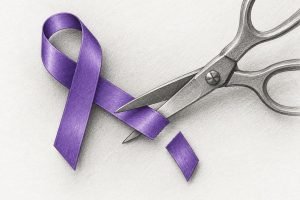
In October, purple shows up everywhere. Ribbons on lapels, buildings lit at dusk, a proclamation read into the minutes at a county commission meeting. Congress designated October as Domestic Violence Awareness Month in 1989, and for nearly four decades the month has done what awareness does — it makes visible something a lot of people were carrying in private.
This year, the organization that runs the national campaign is asking for more than visibility.
The Domestic Violence Awareness Project, a project of the National Resource Center on Domestic Violence, has released its DVAM 2026 materials under the theme “With Survivors, Always.” The framing is explicit. “For DVAM 2026,” the campaign says, “we’re building on that momentum, with a deepened focus on action.” And, more plainly: “Survivors deserve action.”
Last year’s campaign rested on three words — safety, support, solidarity. This year keeps them and adds a verb. The campaign names what it is responding to: violence being minimized, services being cut, and barriers to survivors’ safety that have not gotten smaller. The materials are free to download and use — a flyer, press release templates a local program can send under its own letterhead, printable signs, social media cards, and the hashtags #WithSurvivors and #DVActionMonth.
Awareness is not nothing
It is worth saying clearly, because the criticism of awareness months usually skips it: being seen matters.
For a STAR — a Survivor of a Toxic Abusive Relationship — October is often the first month of the year when the language on the radio matches what happened at home. Coercive control gets named on a morning show. A coworker mentions a statistic. Someone reads a proclamation out loud in a room with folding chairs. For a person who spent years being told they were too sensitive, too dramatic, or imagining things, hearing the pattern described accurately by a stranger is not a small experience. It is often the first crack of daylight.
You were not imagining it. That sentence is worth a month.
And then it is November
Here is the part the campaign is pointing at. The ribbon comes off. The building goes back to white light. The social posts stop, and the person who recognized themselves in one of them is still exactly where they were on September 30 — except now they know what to call it.
The campaign’s line about services being cut is not abstract this year. In New York, 316 organizations asked the state’s Office of Victim Services for $626.1 million over two years; the office had $126.5 million a year to give, and some established programs lost as much as 70 percent of their funding before an eleventh-hour $36 million rescue narrowed the gap. Behind the state numbers is a federal one: the Crime Victims Fund, which pays for most victim services in America out of criminal fines rather than taxes, has been shrinking for years, and every state is deciding one budget cycle at a time how much of the difference to cover. The month that asks the country to see survivors begins just as the system built to help them is being asked to do more with less.
Recognition without a next step is a hard place to stand. Naming what happened to you opens the whole thing up: what it cost, how long it went on, what it did to the way you sleep and trust and answer the phone. Awareness hands someone that, and then October ends.
“With survivors, always” means being there in November too. The always is the whole claim.
What action looks like at human scale
Action, in this month, usually gets described at the policy level — funding, legislation, enforcement. All of that is real and all of it is slow.
There is another kind, and it is the kind STAR Network® was built for: a door that is open the same week a person realizes they need one.
TAR Anon® is a free, anonymous, worldwide peer fellowship for people healing from Toxic Abusive Relationships™. It meets virtually. There is no diagnosis required to attend, no referral, no insurance question, no waitlist, and no cost. Nobody has to have language for it yet. A person can sit in a meeting and say nothing at all, and still be in the room with people who already know the shape of what they are describing.
That is not a substitute for therapy, and STAR Network does not claim it cures anything. It is something else, and something specific: the thing that keeps a survivor from having to hold it alone between the moment of recognition and whatever comes next. Recovery is not a solo act, and fellowship is the form that “always” takes when the ribbons come down.
For organizations that want to do more than post a graphic
Employers reliably participate in DVAM — a lunch-and-learn, a hotline number on the intranet, a purple ribbon at reception. That’s a start, and staff notice when it stops there.
STAR Network’s NorthSTAR program works with organizations on the other half: building workplaces that are trauma-informed year-round, so that an employee living through coercive control at home is not also managing a workplace that cannot hear it. October is a reasonable month to start that conversation. It should not be the only month it happens.
This October
Download the campaign materials from the Domestic Violence Awareness Project and use them — they are good, and they are free. Say the true things out loud in your building and your feed.
Then keep the door open. If you are a STAR reading this, you don’t have to navigate life after abuse alone: TAR Anon meetings are free, anonymous, and open worldwide, this month and every month after it.