By Carey Sipp
Co-Director, Volunteer
PACEs Connection
csipp.pacescommunities@gmail.com
(Activation warning. This is a first-person opinion piece sharing my thoughts on toxic abusive relationships [TAR] and a relatively new 12-step program, TAR Anon, which offers free, solution-oriented, acceptance-based, and psychologically-safe Zoom meetings from 6-7 PM ET on Mondays and Wednesdays, 2:30-3:30 PM ET on Tuesdays and Thursdays, and from 12 Noon-1 PM ET on Fridays. This is a warning regarding potentially activating language, so you can choose whether or not you wish to continue reading. Further, I extend the activation warning to the program’s TAR Tales, where TAR Anon members share their stories.)

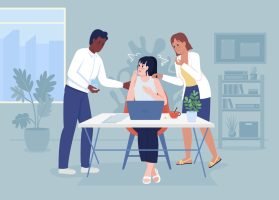
(Illustration from the STAR Network Foundation Instagram site.)
If there are adverse childhood experiences (ACEs) in your past, chances are good that you’ve been in a relationship with what Dr. Jamie Huysman, creator of the rapidly-growing 12-step program TAR Anon (Toxic Abusive Relationships Anonymous), calls a toxic abuser.

Huysman, a licensed clinical social worker (LCSW) and therapist, is the founder and executive director of STAR Network Foundation, Inc., a 501(c)(3) nonprofit organization which includes TAR Anon® and several other programs.
The STAR Network™ is rising in myriad ways.
Hearing Huysman speak regularly in TAR Anon meetings since being introduced to him about six weeks ago, it’s clear to me that he lives the organization’s mission to educate, energize, and empower people by giving them access to programs such as TAR Anon.
Meeting Huysman’s team, attending the two-year-old STAR Network’s Scars to STARs Day global online conference in May, and seeing the impressive list of the organization’s allies provides further evidence of the energy and gravitas backing the campaign to raise worldwide awareness of and treatment for the millions of people “whose emotional reality has been distorted by TAR.”


Also heavily involved is mental health advocate, author, and former U.S. Congressman Patrick Kennedy, who delivered the keynote address at Scars to STARs Day. During his speech, Kennedy – who grew up with the trauma and tragedy of losing two high-profile uncles to assassinations, family addictions (including his mother’s alcoholism), and the intensity of a father who advocated for mental health parity while at the same time self-medicating his grief with alcohol – writes and speaks passionately about his own struggles with bipolar disorder and substance abuse.
The Need for TAR Anon
With one-in-four children in America growing up in a home with at least one parent who has a substance abuse disorder, one-in-five Americans living with some type of mental illness each year, 63.9% of U.S. adults reporting at least one ACE, and 17.3% reporting four or more ACEs, it’s likely most of us have had some experience with traumatic abusive relationships.
This is NOT to say that all people with mental illness or substance abuse disorder are or become toxic abusers. Far from it. Though it has been my experience – and well documented in research and reporting – that when people are depressed, anxious, at the effect of a substance or addictive behaviors, or are experiencing the challenges of mental illness, harsh words, neglect, and addictive behaviors can be among the consequences faced by the troubled person with regard to their own self-talk, as well as proximate family members and friends.
What pushes irritability and lack of awareness of the impact of one’s negative behavior into a diagnosis such as narcissism, borderline personality disorder, or Cluster B personality, as defined in the Diagnostic and Statistical Manual of Mental Disorder, 5th Edition (DSM-5) is a more consistent, pervasive, and intentional pattern of hurtful actions and personality traits that significantly impact relationships and the well-being of others.
TAR Anon is raising awareness of the prevalence of and solutions for these challenges.
Huysman shares in TAR Anon meetings that globally, approximately one-in-eight people have a personality disorder. Estimates in the U.S. are higher, with reports varying between being 10-15%. Regardless of the diagnosis assigned to the abuser, in the 12-step TAR Anon meetings, the person in recovery from abuse is the most important person in the room.
As a person with an ACE score of nine, I can legitimately say there have been some toxic abusers in my life. I have been in therapy for Complex Post-Traumatic Stress Disorder (CPTSD) off and on for many years, and have the entire alphabet soup of different treatment methodologies in my recovery from early and ongoing relational trauma. My toolbox includes CBT (Cognitive Behavioral Therapy), DBT (Dialectical Behavior Therapy), EMDR (Eye Movement Desensitization and Reprocessing), IFS (Internal Family Systems Therapy), years of neurofeedback, two rounds of trans-cranial magnetic stimulation, countless hours of meditation, and a litany of different anonymous programs I will not share to protect my own anonymity, and the sanctity of the programs themselves.
With TAR Anon being a meeting ground for people from many different programs, or none, and toxic abusive relationships being evident in so many public places in our lives today, I am sharing information about this program and my involvement in it for the greater good.
Further, as TAR Anon is also a relapse prevention model that works well as a complement to all other 12-step programs, it can be used as a great primary or companion program.
Out of respect for the privacy of all people, and because dwelling on the past can be its own form of abuse, my toxic abusers will not be mentioned. It’s how I respond to myself and to them that is the most important aspect of this recovery.
Among the most important lessons learned from years of recovery and realizations that come with it, is that as an adult, I am not a victim and that my brain, and I, can change!
Looking back and realizing that even as a little kid I chose toxic friends, I see that the last 20 years have been way different and have given me great hope. Among the realizations that helped me change my thinking was learning that the brain has neuroplasticity – the ability to change throughout life.
This knowledge was and is incredibly freeing. I’ve seen the positive impact of changing my thought patterns, seeing clearly that I wasn’t stuck with the brain I was born with or had trained, as an infant and child by circumstance, to expect toxic inconsistency and unpredictability.
I learned to reparent myself and accept life-changing healing and support. Changing thought patterns is healing and life-changing, and many of the books, workbooks, and practices that have been so helpful to me over years of self-care are listed as resources in all TAR Anon meetings, including The Body Keeps the Score by Bessel van der Kolk, MD, and Complex PTSD, From Surviving to Thriving by Pete Walker.
I’ve also learned through years of therapy, recovery, neurofeedback, meditation, journaling, being in community with sane people who love me, purposeful work I love, exercise, singing in choirs, spirituality, reparenting myself, parenting my children, and spending time in nature, that these resiliency boosters and the right dose of an antidepressant have helped me rewire my brain.
I am now much better at discerning and avoiding toxic people and relationships. The best part of this shift is developing a growth mindset, which has actually helped me attract the kind of people and opportunities that bring me joy and healthy relationships.

Had TAR Anon existed years ago, I might have learned much of this sooner, not had to do so much research, and could have saved many thousands of dollars in therapy.

The great news is that this 12-step program now exists, and I believe it can be a tremendous accelerator, comfort, teacher, friend, and compassionate partner in recovery from all types of ACEs, from the original 10 in the 1998 Kaiser Permanente and CDC (Centers for Disease Control and Prevention) study, to the more expansive and inclusive ones shared in this brilliant illustration created by the North Carolina Partnership for Children.

It is also said that TAR Anon is the only 12-step program whose primary purpose is to help people recover from attachment disorders and CPTSD.
Other important messages I believe one can take from the TAR Anon meetings:
- For most toxic abusers, it’s not their fault. They may have been born into homes where inconsistency, lack of nurturing, unpredictable care, domestic violence, mental illness, substance abuse, physical, verbal, or sexual abuse, neglect, or the death or loss of a parent – resulted in their own anxious, preoccupied, dismissive-avoidant, or fearful-avoidant (disorganized) attachment styles.
- This toxic environment led them to adapt to survive. Adaptations could include, but are not limited to manipulation, dishonesty, abuse, cruelty, and/or addictions to substances or behaviors. They may have seen their parents and caregivers model changing roles as persecutors, rescuers, and victims. The childhood adaptations that helped them survive made it harder for them to attach in a healthy way. That attachment style followed them into adulthood, where it wreaked havoc on the abuser themselves as well as the people with whom they had relationships. And guess what? The same could be said for most victims of toxic abusers.
- Sadly, to feel safe, many of us who grew up in chaos subconsciously recreate the familiar, even if what we are recreating is toxic. Many of us reared in toxic environments fell into the abuser-rescuer-victim cycle until we got some help recognizing the pattern. If help was not available, we might have become or married alcoholics, become gamblers, spenders, workaholics, hoarders, or the type of over-achiever who lands in the hospital from exhaustion, illness, or an epic burnout. I’ve been there.
In over 31 years of 12-step work, I learned early on to take an inventory of my resentments and fears, seeking for my part in any situation where I had a conflict, and looking for the pattern of my behavior so I could help disrupt it. I have also learned the value of accepting input from others to disrupt destructive behavior patterns.
Gratefully, I also learned this in Cognitive Behavioral Therapy (CBT) decades ago. In it, I was able to look at a situation and separate my thoughts, feelings, body sensations, and actions IN WRITING, so I didn’t collapse a story and miss the way I allowed my thoughts to create my emotions, the way I felt, and the way I reacted instead of responded. It’s true that if we knew how powerful our thoughts are, we would be very careful about what we choose to think about, or allow into our precious minds.
See Part 2 of this article on STAR Network.